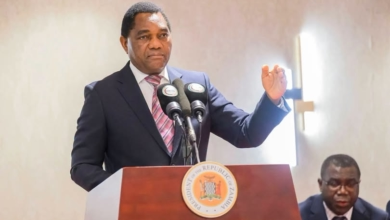


LCK Freedom Foundation has welcomed President Hakainde Hichilema’s decision to refer the Public Gatherings Bill of 2026 back to Parliament for reconsideration, describing the move as a constitutional step that protects fundamental rights and freedoms.
In a statement issued, LCK Freedom Foundation Executive Director Linda Kasonde has said the President’s decision, made under Article 66(1)(b) of the Constitution, demonstrates a commitment to ensuring that laws regulating public order are consistent with constitutional guarantees.
The Foundation notes that civil society organisations, legal practitioners and members of the public had raised concerns that some provisions of the Bill mirrored shortcomings found in the Public Order Act, particularly the broad powers granted to authorised officers to restrict public gatherings and the criminal liability imposed on organisers.
Ms Kasonde says the concerns were rooted in established constitutional principles, citing the Law Association of Zambia v The Attorney-General case, in which the High Court ruled that restrictions on peaceful assembly must be necessary, proportionate and consistent with democratic principles.
She says the judgment affirmed that laws governing public assemblies should facilitate, rather than merely tolerate, the exercise of the right to peaceful assembly.

The Foundation has since urged Parliament to ensure that any revised version of the Bill clearly establishes a notification based system instead of a permission based one, in line with constitutional protections.
It has also called for limits on the discretionary powers of authorised officers, proportionate penalties for breaches of the law, and accessible mechanisms for appeal and judicial review where decisions affect the right to assemble.
Meanwhile, LCK Freedom Foundation has expressed concern over what it has described as inadequate public consultation in the legislative process, arguing that several Bills have been passed without sufficiently reflecting public views.
The organisation says Articles 8 and 9 of the Constitution require meaningful public participation in governance and called on both Government and Parliament to institutionalise genuine public consultation as a key component of law-making.
The Foundation further states that as Zambia approaches the 2026 General Elections, the strength of the country’s democracy will be measured by the quality, constitutionality and legitimacy of its laws.
By Mulenga Chipampe Makasa