


𝗟𝘂𝘀𝗮𝗸𝗮, 𝗪𝗲𝗱𝗻𝗲𝘀𝗱𝗮𝘆,𝟭𝟭𝘁𝗵 𝗡𝗼𝘃𝗲𝗺𝗯𝗲𝗿, 𝟮𝟬𝟮𝟲:
Minister of Labour and Social Security, Hon. Misheck Nyambose, MP, has affirmed that the Emoluments Commission’s mandate does not infringe on trade unions’ collective bargaining rights under the International Labour Organisation (ILO) Convention No. 98.
He emphasised that the Commission’s statutory responsibilities complement, rather than replace, trade unions’ role in negotiating salaries and conditions of service.
The Minister’s remarks are supported by the Commission’s position that it does not participate in collective bargaining negotiations, which remain the responsibility of employers and employee representatives.
Hon. Nyambose expressed strong support for the Commission’s mandate, recognising its critical role in providing remuneration guidance, promoting financial sustainability, and ensuring that workers’ interests are balanced with public institutions’ financial capacity.

The Minister acknowledged that the Commission’s establishment had initially raised concerns within the labour movement about its perceived implications for collective bargaining. However, he noted that the explanation provided by the Commission’s Director General, Mr. Chembo F. Mbula, together with the provisions of the law, had clarified that trade unions retain their bargaining rights, while the Commission sets the parameters within which negotiations are conducted.
He therefore called for intensified stakeholder engagement and public sensitisation to address misconceptions and promote a shared understanding of the respective mandates of the Commission and employee representatives, to strengthen constructive dialogue in the interest of workers and employers.
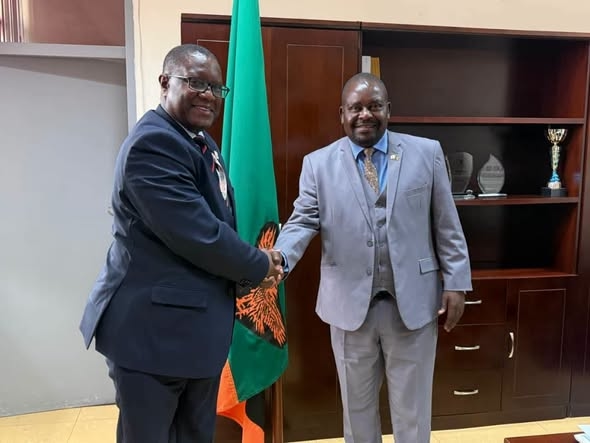
The Minister made the remarks during a courtesy call by Mr. Mbula on 9 November 2026, aimed at strengthening institutional collaboration on public-sector remuneration reforms, labour relations and workers’ welfare.
During the engagement, the Director General congratulated Hon. Nyambose on his appointment and highlighted the complementary mandates of the Commission and the Ministry in advancing fair, equitable and sustainable remuneration practices in support of the Grow Zambia Agenda.
Mr. Mbula outlined the Commission’s mandate under the Emoluments Commission Act No. 1 of 2022 to determine, harmonise and rationalise emoluments in State organs and State institutions. He explained that the mandate covers salaries, allowances and conditions of service, including pension-related benefits, with the aim of addressing long-standing remuneration disparities and strengthening institutional capacity to attract, retain and motivate qualified personnel to improve public service delivery.
Reflecting on the Commission’s early operations, the Director General acknowledged that misunderstandings surrounding its mandate, particularly in relation to collective bargaining, had presented challenges. He noted that these experiences had prompted institutional reflection and reinforced the importance of sustained stakeholder engagement.
Clarifying the Commission’s determination process, Mr. Mbula explained that the Commission distinguishes between management and other non-represented employees, and those represented by trade unions.
For management and non-represented employees, relevant authorities submit recommendations on salaries and conditions of service to the Commission for determination. By way of illustration, where an institution proposes a salary increment of 10 percent, the Commission assesses the recommendation against the principles of affordability and sustainability before making its determination.
The Director General cited past experiences involving some parastatal organisations and local authorities where salary increments had been awarded without adequate consideration of their long-term financial implications. In some instances, institutions could afford the increased salary obligations for only one month and could not sustain payments thereafter.
He emphasised that such experiences demonstrated the importance of ensuring that remuneration adjustments are not only affordable at the point of determination but remain sustainable over time, safeguarding both workers’ interests and institutional financial stability.
For union-represented employees, Mr. Mbula explained that the Commission establishes remuneration parameters within which employers and trade unions undertake collective bargaining. He illustrated that negotiations may take place within an approved range, from zero to a specified upper limit, while taking into account the institution’s financial capacity.
He clarified that the arrangement was not fundamentally different from the practice that existed before the Commission was established, when institutions submitted remuneration proposals through their respective Boards and supervising Ministries for consideration. The Commission now provides a centralised framework for remuneration determination and oversight, promoting greater consistency, fairness and sustainability across State organs and State institutions.
He observed that the centralisation of this function may have contributed to misconceptions about the Commission’s role, and added that the Commission remains open to constructive dialogue with the labour movement.
Hon. Nyambose also welcomed the Commission’s technical advisory role in supporting the Government team during Tripartite Consultative Labour Council (TCLC) engagements, emphasising that closer collaboration with the Director General’s Office would strengthen informed discussions and decision-making on labour and remuneration matters.
The Minister underscored the Ministry’s central role in promoting labour productivity, a key driver of economic growth and national development. He emphasised that achieving the ambitious targets of the Grow Zambia Agenda, including those under the 10-10-5-5-3-3-1-1 framework, requires a productive, motivated and efficient workforce. In this regard, he highlighted the importance of collaboration between the Ministry and the Commission to align sustainable remuneration practices with improved workforce performance, institutional productivity and service delivery.
The engagement reaffirmed the complementary roles of the Ministry of Labour and Social Security and the Emoluments Commission in strengthening remuneration governance, upholding collective bargaining rights, and promoting industrial harmony through fair, equitable and sustainable remuneration practices, all in support of the Grow Zambia Agenda


