
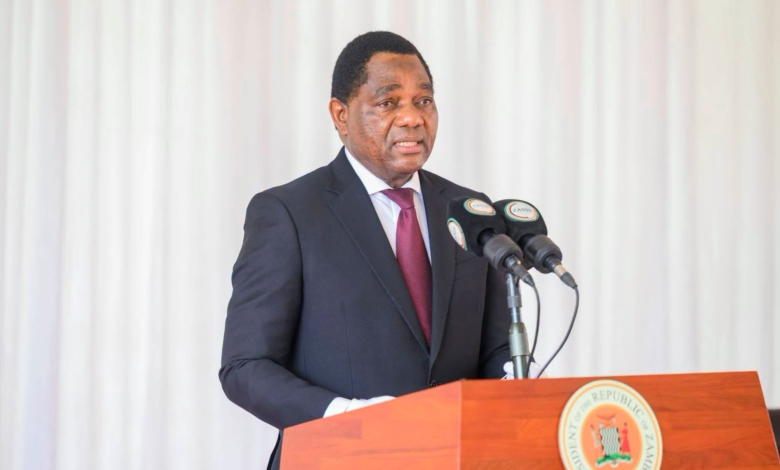
President Hakainde Hichilema says the Zambia-Lobito Rail Project is a visionary initiative that will unlock trade, promote industrialisation and strengthen economic integration across Africa.
Speaking during a courtesy call by Africa Finance Corporation (AFC) President and Chief Executive Officer Samaila Zubairu at State House, President Hichilema says the project would facilitate the movement of goods, connect producers to markets and accelerate the actualisation of the African Continental Free Trade Area.
President Hichilema says the railway would link Zambia with its neighbours, particularly the Democratic Republic of Congo and Angola, while supporting the movement of locally produced commodities, including maize and mealie meal, to markets where they are needed.
He says the project is important not only to Northwestern and Copperbelt Provinces, where the railway will pass, but also to Central, Lusaka, Southern, Northern and Muchinga Provinces through wider economic connections.
Meanwhile, Mr Zubairu says the project is a significant milestone for Zambia and Africa, as it would go beyond railway infrastructure to establish industrial cities, develop value chains and create opportunities for infrastructure and industrial planning.

He says the project is a cornerstone of AFC’s Africa We Build initiative, aimed at promoting prosperity, dignity and economic transformation across the continent by 2050.
Mr Zubairu says the project had received development support from the governments of Italy and the European Commission, but would require initial viability gap funding to be jointly provided by Zambia and Angola.
He says the project would also create employment opportunities through construction and industrial activities, stressing the need for deliberate planning to ensure that new settlements and supporting infrastructure emerge in an organised manner, without creating slums.
Mr Zubairu further adds that the project would help Africa match its natural resources with production and consumption needs, while strengthening local manufacturing and creating jobs for its people.
By Victoria Kayeye Yambani