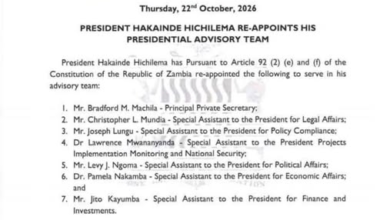

Government has asked Parliament to approve a proposed realignment of ministries that would result in a structure of 30 ministries aimed at improving efficiency and public service delivery.
President Hakainde Hichilema has written to Parliament seeking approval for the proposed establishment, merger and dissolution of Government ministries under Article 92(2)(d) of the Constitution.
Vice President W.K. Mutale-Nalumango is expected to move a motion in Parliament seeking approval for the proposed changes.
The realignment is intended to improve the operations of Government and ensure that its structure supports the Grow Zambia Agenda and better public service delivery.
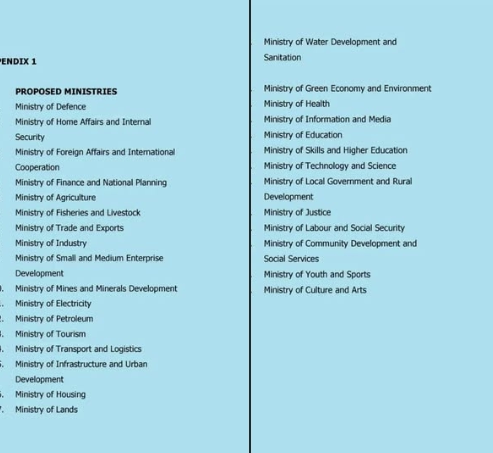
The proposal, contained in a notice of motion in the Supplement to the Votes and Proceedings of October 23, provides for 30 ministries, with some existing portfolios proposed to be divided into separate ministries.

Under the proposal, the existing Ministry of Energy would be separated into the Ministry of Electricity and the Ministry of Petroleum.
The current Ministry of Commerce, Trade and Industry would be reorganised into three ministries: the Ministry of Trade and Exports, the Ministry of Industry, and the Ministry of Small and Medium Enterprise Development.
In the education sector, the proposed structure provides for a Ministry of Education and a separate Ministry of Skills and Higher Education, while the Ministry of Technology and Science would remain a distinct portfolio.
The existing Ministry of Infrastructure, Housing and Urban Development would be divided into the Ministry of Infrastructure and Urban Development and the Ministry of Housing. The Ministry of Lands and Natural Resources would also become the Ministry of Lands.
The current Ministry of Youth, Sport and Arts would be separated into the Ministry of Youth and Sports and the Ministry of Culture and Arts.
The 30 proposed ministries are Defence; Home Affairs and Internal Security; Foreign Affairs and International Cooperation; Finance and National Planning; Agriculture; Fisheries and Livestock; Trade and Exports; Industry; Small and Medium Enterprise Development; Mines and Minerals Development; Electricity; Petroleum; Tourism; Transport and Logistics; Infrastructure and Urban Development; Housing; Lands; Water Development and Sanitation; Green Economy and Environment; Health; Information and Media; Education; Skills and Higher Education; Technology and Science; Local Government and Rural Development; Justice; Labour and Social Security; Community Development and Social Services; Youth and Sports; and Culture and Arts.
The proposed structure also outlines the responsibilities and statutory institutions that would fall under the respective ministries and the offices of the President and Vice President.
The motion is scheduled for consideration by Parliament on Tuesday, October 27, 2026.
The proposed changes have not yet taken effect, as Parliament is being asked to approve the new structure.
By Mike Mwendachabe